

 English
 Nederlands
 Polski
Dutch on site. Check the dimension before you cut
You hear a number while a colleague points to a doorway. Before you mark the timber, establish which opening they mean, which dimension they need and which unit they are using.
HR Kamer ·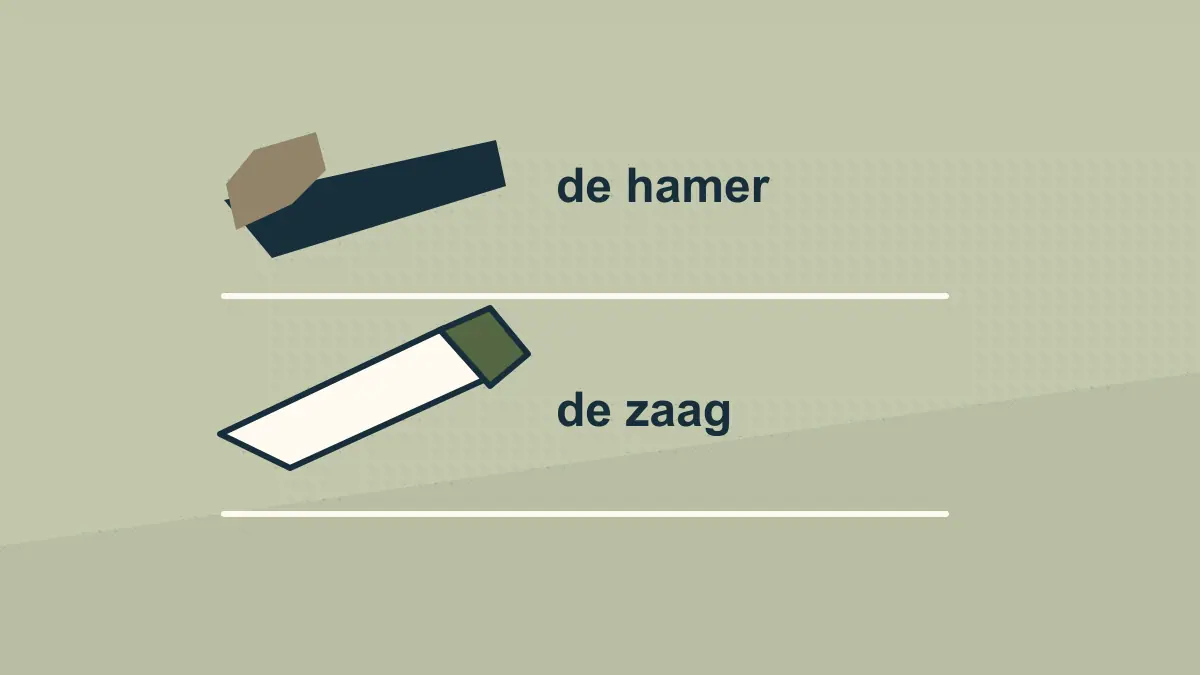
Point to the part you mean
On a sketch of a doorway, label the frame “het kozijn”, the door leaf “het deurblad” and a hinge “het scharnier”. A useful first question is “Bedoel je dit kozijn of het kozijn ernaast?” (Do you mean this frame or the one next to it?). If there are several identical openings, ask “Welk nummer staat er op de tekening?” and put that drawing reference beside your measurement.
Repeat the number and the unit
“Wat is de breedte van de opening?” asks for the width of the opening. Say the answer back as a whole. “Ik heb achthonderdtwintig millimeter opgeschreven. Klopt dat?” means “I’ve written down 820 millimetres. Is that right?” Ask a colleague to read 82 and 820 in a random order while you write them down. Keep millimetres and centimetres visible beside every figure when you check your answers.
Ask for a decision you can act on
Imagine the drawing gives 820 mm and you measure 815 mm at the opening. Explain the difference with “Op de tekening staat 820 millimeter. Hier meet ik 815. Welke maat moet ik aanhouden?” Wait for the answer before cutting. If the foreman points at the frame, check the reference edge with “Vanaf welke kant moet ik meten?” (Which side should I measure from?).
Build tomorrow’s word list
Open hand tools and fixings in HR Kamer’s construction dictionary. Choose one item to measure with, one fixing and one phrase for requesting a check. The Dutch words have Polish explanations. Look at the illustrations, cover the labels and ask a colleague for the object in a complete sentence. On the next job, replace the noun and keep the rest of the question. You now have a phrase you can use with several tools.